


🔄 Last updated: 12 July 2026
Two foreigners live in Da Nang. Same apartment block, same café, same remote job for a client abroad.
Both keep perfectly valid visas. Both do their border runs on schedule, never a day over.
One is compliant. The other may have an undeclared tax liability.
The only difference between them: the number of days.
What a border run does NOT do
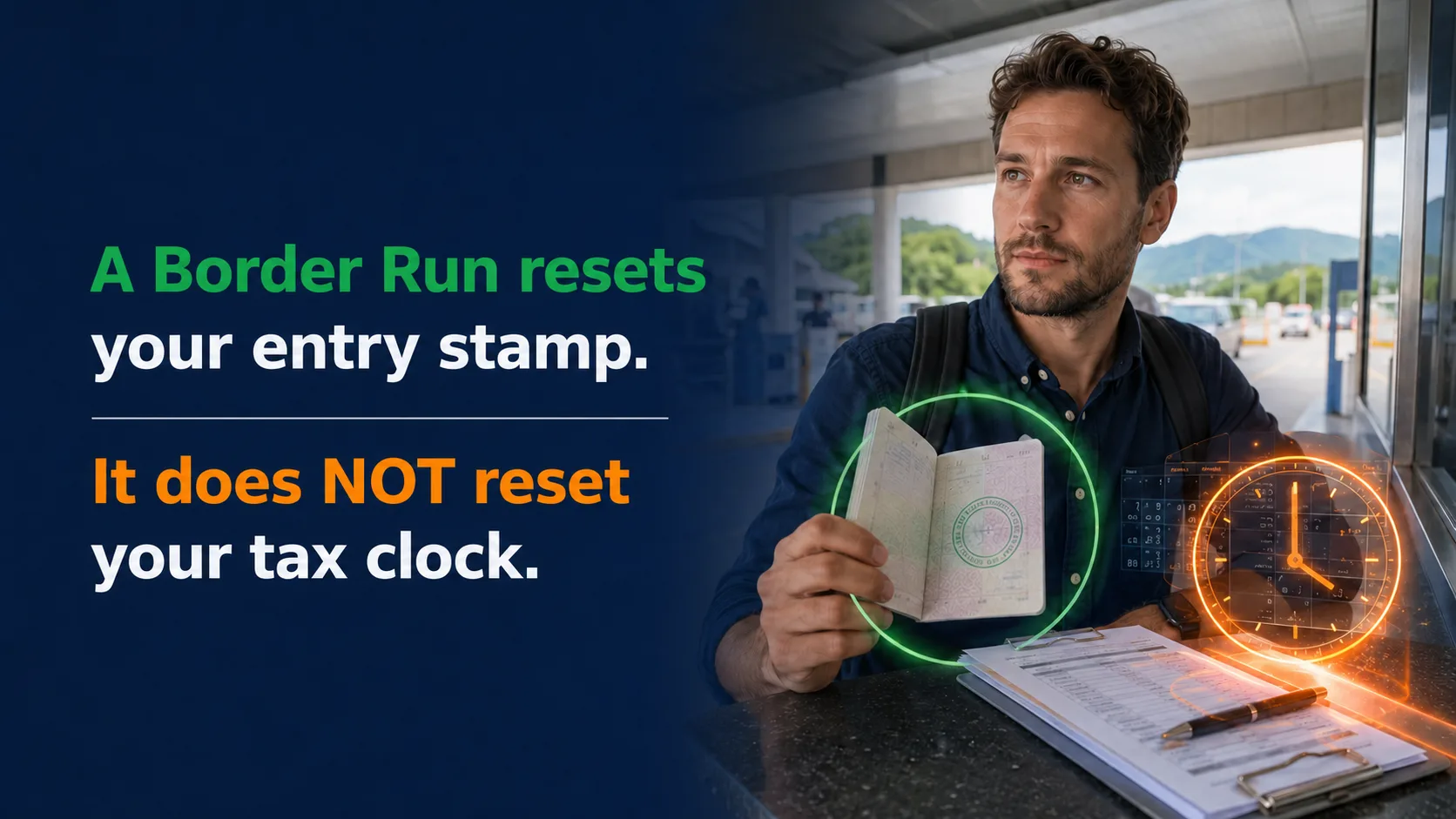
You exit to Cambodia. You come back. You get a fresh stamp, a fresh 45 days.
Your visa clock has been reset.
But a second clock is running — and it doesn't care how many times you left the country.
🔴 The tax clock counts your TOTAL DAYS PRESENT.
Not consecutive days. Not each entry separately.
The total.
And worse: the date of arrival and the date of departure are each counted as one (01) day. Where a person enters and exits on the same day, that still counts as one day of residence.
Meaning your same-day border run — out at 6am, back by 8pm — still counts as ONE DAY OF RESIDENCE.
It doesn't subtract. It adds.
⚖️ TWO COLUMNS — which one are you in?
| NON-RESIDENT INDIVIDUAL | RESIDENT INDIVIDUAL | |
|---|---|---|
| Test | Under 183 days and no regular place of abode | ≥ 183 days in a calendar year or in any 12 consecutive months — or a regular place of abode |
| 🔑 Taxable income | Only income arising IN Vietnam | 🔴 Income arising INSIDE AND OUTSIDE Vietnam — regardless of where it's paid |
| Rate | Flat 20% | Progressive 5% → 35% |
| Personal deductions | ❌ None | ✅ Yes (self VND 11m/month, each dependant VND 4.4m/month) |
| Filing | Usually withheld at source by the payer | Declaration and annual finalisation |
Read the second row again.
For a resident individual, taxable income is income arising inside and outside the territory of Vietnam, REGARDLESS OF WHERE THE INCOME IS PAID.
For a non-resident individual, taxable income is income arising in Vietnam, regardless of where it is paid or received.
🔴 What this means if you work remotely
You live in Da Nang. You work for a company in Berlin. They pay into your German bank account.
You assume that money "has nothing to do with Vietnam."
If you are a Vietnamese tax resident, that income falls within the scope of taxable income under the rule — "regardless of where the income is paid."
The fact that the money never touches Vietnam does not place it outside the rule.
😳 THE SECOND ROUTE to tax residency — the one nobody tells you about
This is the part that catches people.
You don't need 183 days.
A resident individual is someone who meets ONE OF TWO conditions: present for 183 days or more; OR having a regular place of abode in Vietnam, including a registered place of permanent residence or A LEASED HOUSE in Vietnam under a term lease (leased for dwelling).
More precisely: a house-lease contract for dwelling in Vietnam with a term of 183 days or more in the tax year.
🏠 THE LEASE TRAP
You rent an apartment in Nha Trang on a 12-month lease — because long leases are cheaper.
But you're actually only in Vietnam for 100 days that year; the rest of the time you're in Thailand, back home, travelling for work.
You assume you're safe because you're under 183 days.
But a lease of 183 days or more may make you a tax resident on its own.
The test is "ONE OF" — not "ALL OF".
A great many foreigners in Vietnam hold a 6-month or 12-month lease and have never once thought about this.
🔍 How does the tax authority count your days?
With your passport.
The date of arrival and the date of departure are based on the certification of the immigration authority in the individual's passport (or travel document) on arrival in and departure from Vietnam.
The entry and exit stamps in your passport are the tax authority's timesheet.
Not your word. Not your memory. The stamps.
And every time you do a border run, you personally create another pair of stamps — clear, dated, state-issued evidence.
🔗 This is where two of our articles connect
The stamp determines the day you must leave Vietnam (immigration law).
The stamp also determines whether you're a tax resident (tax law).
The same stamp. Two entirely different legal consequences.
🔔 Do you actually know how many days you've spent in Vietnam in the last 12 months?
Most people don't. They guess.
And 183 is not a number to guess at.
👉 Track your days with Visa Tracker — free, no account needed. The same data that keeps your visa valid also tells you where you stand against the 183-day line.
If you're approaching it, that's the moment to talk to a tax professional — not after the tax year has closed.
🧮 One more detail: "12 consecutive months"
This is where people miscalculate.
You are not only assessed by the calendar year.
Present in Vietnam for 183 days or more in a calendar year OR within 12 consecutive months from the first day of presence in Vietnam.
Example: you arrive in August 2025. By 31 December 2025 you've been here only 150 days — under 183.
You assume you're a non-resident for 2025. Correct — if you only look at the calendar year.
But where a foreigner is in Vietnam for fewer than 183 days in a calendar year but the total from the first day of presence over 12 consecutive months reaches 183 days or more, the first tax finalisation year is assessed over those 12 consecutive months from the first day of presence.
Which means you can become a tax resident in your first "tax year" — without a single full calendar year having passed.
🌍 So am I taxed TWICE?
Not necessarily. This is the good news.
Vietnam has signed Double Taxation Agreements (DTAs) with a large number of countries.
Where the foreigner's country has a Double Taxation Agreement with Vietnam, they may be exempted from or granted a partial reduction of tax.
But — and this is the crux:
A DTA does not apply automatically. You must declare and file to claim its benefit.
You cannot skip your filing obligation and then say "but my country has a treaty."
A treaty is a tool to avoid paying tax twice — not a reason not to file.
✅ WHAT TO DO — by group
🧳 You're a tourist here a few weeks a year → Nothing to do. You're far from 183 days and hold no long lease.
🔁 You live in Vietnam by doing border runs / visa runs year-round → 🔴 You have almost certainly passed 183 days. → Recount your days over the past 12 months — from the stamps, not from memory. → Talk to a Vietnamese tax professional. Not us. Not a Facebook group.
🏠 You hold a lease of 6 months or more → ⚠️ You may already be a tax resident — even under 183 days. → Check the term on your lease.
💼 You work formally for a Vietnamese company → Your employer usually withholds your tax at source. But if you ALSO have income from abroad and you're a resident — that falls within scope too. → Working legally in Vietnam: five routes
🧑💻 You work remotely for foreign clients and live here year-round → 🔴 This is the highest-risk group, and the least warned. → You need professional tax advice. Now.
⚠️ Common misconceptions
❌ "I border-run every 45 days, so the clock always resets." → YOUR VISA CLOCK resets. YOUR TAX CLOCK does not. Tax counts total days present, not consecutive days.
❌ "A same-day border run doesn't count." → IT COUNTS. Entering and exiting on the same day still counts as one day of residence.
❌ "My salary is paid abroad, so Vietnam isn't involved." → CHECK AGAIN. For a resident individual, taxable income is income arising inside AND outside Vietnam — "regardless of where the income is paid."
❌ "I'm only here 150 days, so I'm definitely a non-resident." → NOT NECESSARILY. Two reasons: (1) the 183-day test also runs over any 12 consecutive months, not just the calendar year; (2) a lease of 183 days or more may make you a resident on its own.
❌ "I don't have a tax code, so I don't have to file." → NOT HAVING A TAX CODE IS NOT AN EXEMPTION. The obligation arises from your residency status and your income — not from whether you've registered.
❌ "My country has a double-tax treaty, so I don't need to do anything." → FALSE. A treaty stops you being taxed twice — but you still have to declare and file to claim it.
❌ "Who would even know?" → THE STAMPS IN YOUR PASSPORT KNOW. And the rules say the tax authority relies on exactly those stamps.
Sources
- Personal Income Tax Law 2007 (as amended) — Art. 2 (resident / non-resident individuals); Art. 22 (progressive tax table); Art. 25 (rate for non-resident individuals)
- Decree 65/2013/NĐ-CP — detailing the Personal Income Tax Law
- Circular 111/2013/TT-BTC (Ministry of Finance, amended by Circular 119/2014/TT-BTC):
- Art. 1 — scope of taxable income: residents — income arising inside and outside Vietnam; non-residents — income arising in Vietnam
- Art. 2 — determining residency; arrival/departure dates based on the immigration authority's certification in the passport
- Art. 9 — personal and dependant deductions
- Arts. 18 and 25 — the 20% rate and withholding at source for non-residents
- Resolution 954/2020/UBTVQH14 — deduction thresholds
- Double Taxation Agreements (DTAs) between Vietnam and other countries
- General Department of Taxation — Ministry of Finance
⚠️ ESPECIALLY IMPORTANT NOTE: This article compiles publicly available rules as of the update date for the purpose of RAISING AWARENESS, and is NOT TAX ADVICE.
Personal income tax is a complex field, depending on your nationality, income type, applicable double-taxation treaty, residency status in your home country, and individual circumstances. Tax policy is also undergoing revision.
We CANNOT tell you whether you have a tax liability. Only a licensed Vietnamese tax professional, after reviewing your actual circumstances, can do that.
If you have been in Vietnam close to or beyond 183 days, seek professional tax advice — AS SOON AS POSSIBLE. Undeclared obligations typically grow more expensive over time through late-payment interest and penalties.
ViEntry is a technology platform connecting users with independent visa and eSIM service operators. ViEntry does NOT provide tax services, is NOT a tax authority, and takes NO responsibility for your tax obligations.
We wrote this because it is the risk our own Visa Run Tour customers are least often warned about — and we think you deserve to know.
Not sure how many days you've been here? Start by counting the stamps — then take that number to a tax professional. Telegram @vientry_support · WhatsApp +84 963 091 001 · Hotline 0963 091 001