



🔄 Last updated: 12 July 2026
Most foreigners fined for overstaying in Vietnam aren't careless people.
They're people who looked at the wrong thing.
They looked at their visa — the neatly printed number, the clear date, the official document. Entirely reasonable.
And it's the wrong document.
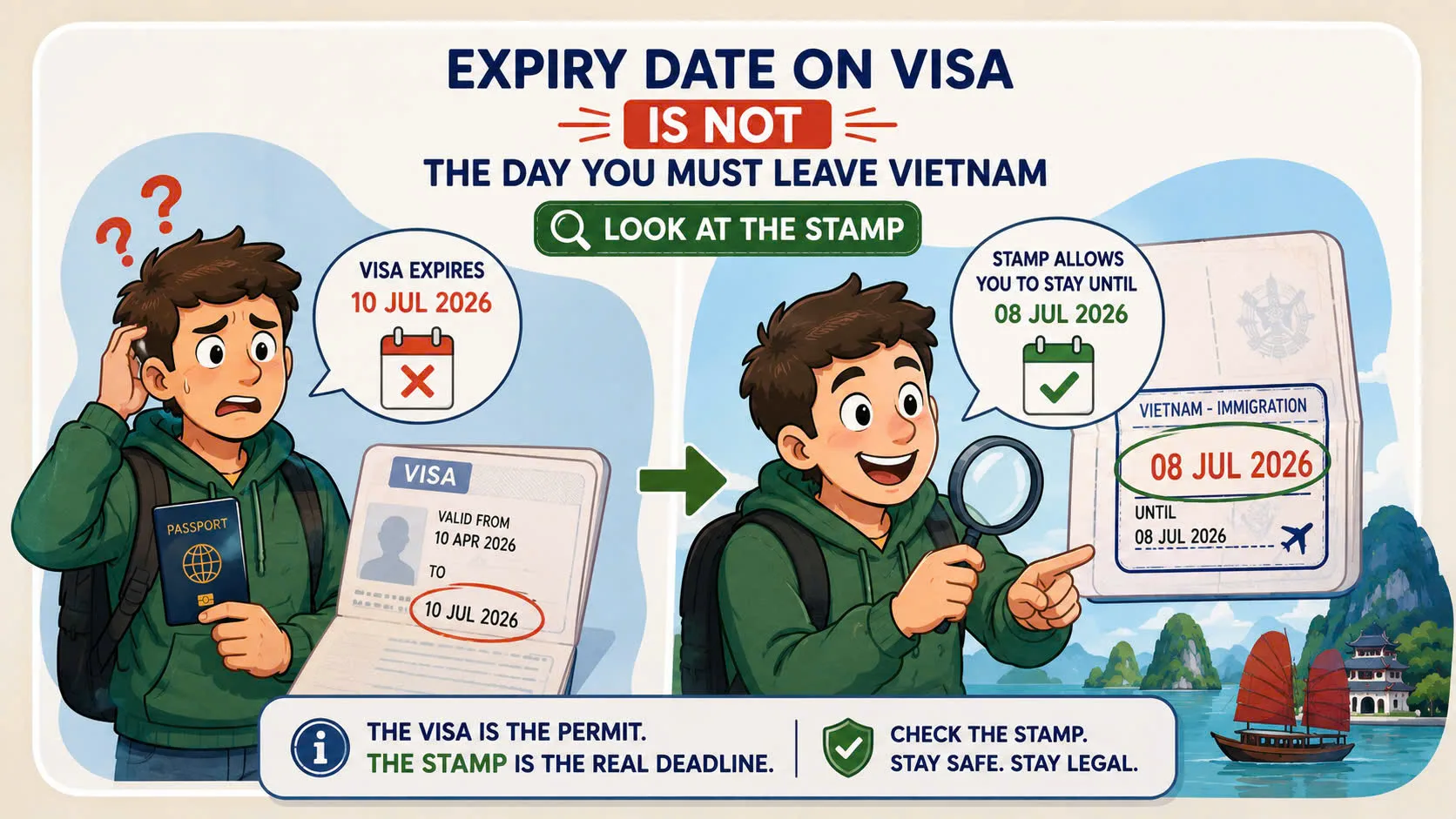
1. 🔍 Open your passport. There are two different things in there.
| THE VISA | THE TEMPORARY RESIDENCE CERTIFICATE (the stamp) | |
|---|---|---|
| What it is | Permission to ENTER | Permission to STAY |
| Who issues it | The visa-issuing authority (before your trip) | The immigration control unit at the border gate (as you cross the counter) |
| Form | Electronic / sticker | An ink stamp in your passport |
| Answers | "Can I get in?" | 🔑 "What day must I leave?" |
Article 31 of the Law on Entry, Exit, Transit and Residence of Foreigners in Vietnam states it plainly:
The immigration control unit issues a temporary residence certificate to a foreigner on entry by stamping the passport or stamping a loose-leaf visa.
Your visa lets you knock on the door. The stamp tells you how long you may stay inside.
2. How your permitted stay is calculated
The base rule, under Article 31:
The temporary residence period granted equals the visa's validity period; where the visa has 15 days or less remaining, 15 days is granted; where the visa carries the symbol ĐT or LĐ, the temporary residence granted is no more than 12 months, and a temporary residence card may be considered.
Read that last clause again.
⚠️ Trap 1: A 5-year visa ≠ a 5-year stay
You hold a 5-year ĐT1 visa. You assume you can stay five years.
You can't. The entry stamp grants you at most 12 months. After that you must obtain a temporary residence card — or leave.
This is precisely why the TRC exists. It's the thing that replaces a visa and gives you genuine long-term residence.
3. 🚨 Trap 2: "Multiple entry" does not mean "stay longer"
You paid USD 50 rather than USD 25 to get a multiple-entry E-Visa instead of single-entry.
You assume you just bought more time.
In terms of how long you may stay, you bought nothing.
- Multiple entry = you may come and go repeatedly within the visa's validity
- It does NOT let you stay longer on any single entry
- Every entry earns a NEW STAMP — and that stamp is what counts the days
You bought travel flexibility. Not residence time.
4. 🚨 Trap 3: Your permitted stay CAN BE SHORTENED
Almost no visa blog mentions this.
Article 31(3) provides:
The temporary residence period may be ANNULLED or SHORTENED by the immigration authority where the foreigner violates Vietnamese law.
Meaning: the number on your visa is not a promise.
It's a ceiling. The stamp is the reality. And that reality can change.
→ This is the final, decisive reason to LOOK AT THE STAMP, not the visa.
🔔 The 60-second exercise — do it now
Don't finish the article. Do this first.
1. Open your passport. 2. Find the most recent entry stamp (ink, not the visa sticker). 3. Read the date on it. That is the day you must leave Vietnam. 4. Compare it with the date you thought it was.
If those two dates differ — you've just avoided a fine.
👉 Enter the date from the STAMP into Visa Tracker — free expiry reminders before it's too late. Not the date on your visa. Not the date you remember. The date on the stamp. Free, no account needed.
5. If you're visa-exempt: the stamp is still king
No visa? You still have a stamp. And it still decides.
- Your entry date is DAY 1. Not the day after.
- 45-day exemption — under Resolution 44/NQ-CP (Russia, South Korea, Japan, UK, France, Germany, Italy, Spain, Denmark, Sweden, Norway, Finland): regardless of passport type or purpose of entry, valid until 14 Mar 2028
- Resolution 229/NQ-CP (12 further EU countries): 45 days, tourism purposes only, until 14 Aug 2028
- No in-country extension. When 45 days are up, they're up.
⚠️ A discrepancy we have to name: some airline lists still show 13 countries, including Belarus — under Resolution 128/NQ-CP (in force 15 Aug 2023), granting visa exemption with a 45-day temporary residence period from the date of entry, regardless of passport type and purpose of entry. Whereas Resolution 44/NQ-CP (2025) lists 12 countries and does not include Belarus.
Public sources do not agree on this point. We will not speculate. If you hold a Belarusian passport, confirm directly with the authorities or your airline before you travel.
6. ⛔ The heaviest consequence: overstaying means you're NOT ELIGIBLE TO EXIT
This is the part people get completely backwards.
Many assume: "Worst case, I go to the airport, pay the fine, and fly home."
It isn't that simple.
Article 27 provides that a foreigner may exit when they satisfy all of the following:
1. A passport or valid international travel document; 2. A VALID temporary residence certificate, temporary residence card or permanent residence card; 3. Not being subject to suspension of exit.
Read condition 2 again.
Your temporary residence certificate ceases to be valid the moment you overstay. Which means you don't meet the conditions to exit — you must resolve the violation first, then travel.
And Article 30 provides: a foreigner whose temporary residence period has expired but who has not exited is subject to forced exit.
Forced exit = a 6-month re-entry ban.
Plus the fine under Decree 282/2025/NĐ-CP — VND 500,000 – 2,000,000 (under 16 days), jumping to VND 5–10 million (from day 16).
→ The full 7-band overstay fine table
7. 📋 Four numbers you carry — and only one that actually matters
| The number | What it tells you | Is it your departure date? |
|---|---|---|
| Passport expiry | How long your passport is usable | ❌ No |
| Visa expiry | How long you may enter | ❌ No |
| TRC expiry (if you have one) | How long you may reside | ✅ Yes — a TRC replaces a visa |
| 🔑 The date on the ENTRY STAMP | How long you may stay | ✅ YES. This is the number. |
If you don't hold a TRC — the stamp is the only answer.
8. So what do you do when the stamp is about to expire?
Three options. There is no fourth.
① Leave Vietnam. Simplest, cheapest.
② Exit and re-enter on a new visa — you'll receive a new stamp, and the clock restarts. → Visa Run · Border Run
③ Apply for a TRC — if you qualify. This is the only route out of the stamp loop altogether. → The TRC: 5 conditions
⚠️ Important: an E-Visa cannot be extended from inside Vietnam. If you plan to obtain a new E-Visa, note that you cannot apply from within Vietnamese territory — and the official process can take up to 15 working days. Don't leave it to the last day.
⚠️ Common misconceptions
❌ "My visa says 90 days, so I get 90 days." → CHECK THE STAMP. The permitted stay equals the visa validity as a general rule — but the stamp is the legal instrument that certifies it. And it can be shortened.
❌ "Multiple entry means I can stay longer." → FALSE. Multiple entry = come and go repeatedly, not stay longer. Each entry has its own stamp.
❌ "I have a 5-year ĐT visa, so I can stay 5 years." → FALSE. ĐT and LĐ visas grant no more than 12 months of temporary residence per entry. To stay longer → get a TRC.
❌ "The arrival day doesn't count; it starts the next day." → FALSE. Your entry date is DAY 1.
❌ "If I overstay, I'll just pay at the airport and fly out." → BE CAREFUL. Under Article 27, a valid temporary residence certificate is a condition of exit. Overstaying = not eligible to exit until the violation is resolved. Report proactively to the Immigration Division — don't just show up at the airport and hope.
❌ "The stamp is a formality; the visa is the real document." → THE REVERSE. The stamp IS the temporary residence certificate under Article 31. It is the real document.
❌ "I have a TRC, so I still need to watch the stamp." → NO NEED. If you hold a valid temporary or permanent residence card, you are not issued a temporary residence certificate on entry — your card replaces it. In that case, the date on your card is your date.
Sources
- Law on Entry, Exit, Transit and Residence of Foreigners in Vietnam (Law 47/2014/QH13, amended 2019, 2023):
- Art. 27 — conditions for exit (requires a valid temporary residence certificate)
- Art. 30 — forced exit where the temporary residence period has expired without exit
- Art. 31 — temporary residence certificate (stamped in the passport); permitted stay equals visa validity; ĐT/LĐ capped at 12 months; may be annulled or shortened
- Art. 38 — the temporary residence card, which replaces a visa
- Decree 282/2025/NĐ-CP — in force 15 Dec 2025, Article 21, overstay penalties
- Resolution 44/NQ-CP (7 Mar 2025) and Resolution 229/NQ-CP (11 Aug 2025) — 45-day visa exemptions
- Resolution 128/NQ-CP (in force 15 Aug 2023) — raised the temporary residence period to 45 days; 13-country list (cited for comparison — see the Belarus note in section 5)
- Tay Ninh Provincial Police — advisory to check the permitted stay shown on the visa or the entry stamp immediately on arrival
- Vietnam Immigration Department — Ministry of Public Security:
evisa.gov.vn
Note: This article compiles publicly available rules as of the update date and is not legal advice. How the rules apply depends on your visa type, nationality and circumstances. If your stamp and your visa show two different dates, contact the Immigration Division for confirmation. ViEntry is a technology platform connecting users with independent service operators; ViEntry is not an immigration authority and does not guarantee visa outcomes. All prices are for reference.
Can't read the stamp in your passport? Send us a photo and we'll read it for you. Telegram @vientry_support · WhatsApp +84 963 091 001 · Hotline 0963 091 001