


🔄 Last updated: 11 July 2026
In four recent articles we've stuck a "grey zone — consult a lawyer" warning on this topic without answering it.
Today we answer it.
Not because we're lawyers — we aren't, and ViEntry does not provide work permit services. But because on this question, silence is more dangerous than an honest answer.
⚠️ First: two decrees you're reading about online are NO LONGER IN FORCE
If the article you're consulting cites Decree 152/2020 or Decree 70/2023 — that article is out of date.
From 7 August 2025, Decree 219/2025/NĐ-CP came into force and entirely replaced Decree 152/2020/NĐ-CP and Decree 70/2023/NĐ-CP.
A key change of authority: the provincial People's Committee now has the authority to issue, re-issue, extend and revoke work permits — usually delegated to the Department of Home Affairs, no longer the Department of Labour, Invalids and Social Affairs.
→ 7 outdated Vietnam visa facts
🗺️ The map: which route are you on?
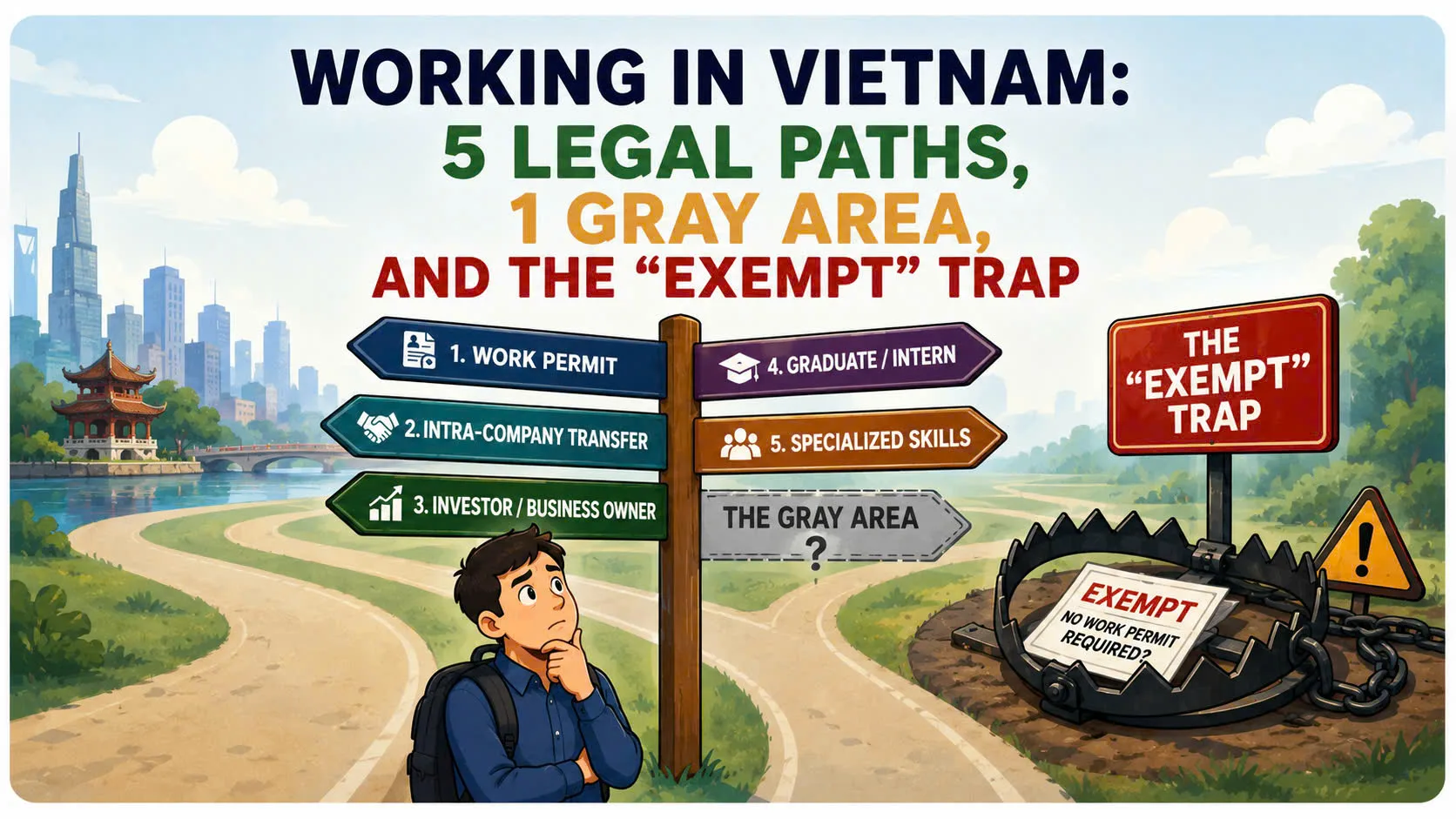
Under Decree 219/2025, you count as a foreign worker if you come to Vietnam to work under one of 13 forms (labour contract, intra-company transfer, service contract, offering services…) and hold one of 4 positions: Manager · Executive Director · Expert · Technical Worker.
From there: five legal routes — and one grey zone.
🛣️ Route 1 — WORK PERMIT
Who: Someone with a labour contract with a Vietnamese employer, not in an exempt category.
How:
- The application is filed by the employer (not by you)
- Filed with the provincial People's Committee (usually via the Department of Home Affairs) where you'll work
- The competent authority reviews and issues the permit within 10 working days of receiving a complete file
- Decree 219 merged the "explanation of need for foreign labour" report into the work permit application itself — one step fewer than before
Leads to: an LĐ1 / LĐ2 visa → a TRC of up to 2 years.
🛣️ Route 2 — CONFIRMATION OF WORK PERMIT EXEMPTION
The most misunderstood route, and the biggest trap in this whole article.
Article 7 of Decree 219/2025 sets out 15 categories exempt from a work permit, including:
- Investors, owners or capital contributors of VND 3 billion or more
- Heads of representative offices or projects of international or foreign NGOs
- Lawyers licensed to practise in Vietnam
- People performing an economic contract or agreement between a Vietnamese and a foreign enterprise
- Foreigners married to Vietnamese citizens (set out more clearly under Decree 219)
- 🆕 People working in finance, science, technology, innovation, national digital transformation — subject to confirmation by a ministry or the provincial People's Committee
- 🆕 Managers / executive directors / experts / technical workers working under 90 days total in one year (1 Jan to 31 Dec)
🚨 THE TRAP: "Exempt" ≠ "Nothing to do"
Work permit exemption does not mean there is no paperwork or administrative procedure. In practice, 13 of the 15 categories are still required to obtain a Confirmation of Non-Applicability of a Work Permit, or to give at least 3 working days' prior notice.
In other words: you may be exempt, but if you skip the confirmation procedure — you can still be treated as working without a permit.
This is where a great many foreigners — and the Vietnamese companies employing them — are in breach without any idea that they are.
Procedure: file Form No. 01 with the Department of Home Affairs – provincial People's Committee. Within 5 working days of receiving a complete file, the authority issues the confirmation on Form No. 02. The confirmation is valid for up to 2 years.
That confirmation is the legal basis for an LĐ visa and a TRC. Without it, your long-term residence route stops dead.
🛣️ Route 3 — INVESTOR VISA (ĐT1 / ĐT2 / ĐT3)
Who: Investors contributing capital to a Vietnamese enterprise.
Leads to: a TRC of up to 10 / 5 / 3 years depending on the symbol — the longest route of all.
⚠️ Note though: even an investor contributing VND 3 billion+ — who is exempt from a work permit — still must obtain the exemption confirmation in order to legalise their working status and to support a visa and TRC application.
→ The TRC and its 5 conditions
🛣️ Route 4 — FAMILY VISIT VISA (TT)
Who: Someone with a spouse or child who is a Vietnamese citizen or a lawfully resident foreigner.
Leads to: a TRC of up to 3 years.
💡 And if you're married to a Vietnamese citizen: you fall into a work permit exempt category under Decree 219 — but you still have to complete the confirmation procedure (see Route 2).
🛣️ Route 5 — 🆕 UĐ1 / UĐ2 VISA (digital technology talent)
New from 1 July 2026, under the amended Immigration Law.
- UĐ1 — talent in the digital technology field
- UĐ2 — family members
Valid for up to 5 years. This is the newest route, and the closest thing to the "visa for tech people" many have been waiting for.
→ The amended Immigration Law, 1 July 2026
🌫️ THE GREY ZONE: You work remotely for a foreign company
Here we'll be honest, including when the honest answer is "we don't know for certain."
Vietnam currently has NO official digital nomad visa.
And here's the structurally interesting part:
Decree 219/2025 defines a "foreign worker" through 13 forms of work — every one of which is tied to an employer, a partner, or an activity IN Vietnam.
Someone sitting in Nha Trang working on a laptop for a company in Berlin, with no client and no employer in Vietnam, does not fit neatly into any of them.
We could not find a published rule that clearly and definitively addresses this case.
We're writing exactly that. Not "it's legal." Not "it's illegal." We have no authority to say either of those things.
But here are three risks that are real and clearly set out:
⚠️ Risk 1 — Activity inconsistent with your declared purpose of entry Under Decree 282/2025/NĐ-CP, entering and operating inconsistently with your declared purpose can draw a fine of VND 20–25 million.
⚠️ Risk 2 — Working without a work permit Under Article 153 of the Labour Code 2019, a foreign worker in Vietnam without a work permit is subject to forced exit or deportation. → Forced exit = a 6-month re-entry ban. Deportation = a 3-year ban.
⚠️ Risk 3 — You can't get a TRC An E-Visa and a tourist visa do not qualify you for a TRC. So even after five years here, you're building a life on a chain of 90-day visas.
🧭 If you're working remotely in Vietnam, here's what to do — in order:
1. Consult an immigration lawyer in Vietnam. Not a Facebook group. Not this blog post. 2. Check whether you fall into one of the 15 exempt categories — especially the technology / digital transformation group, or marriage to a Vietnamese citizen. 3. Watch the UĐ1 visa, in force since 1 July 2026. 4. Don't overstay while you're still looking for the answer.
🔔 While you look for your route, the clock keeps running
The most ironic thing about this whole topic.
Most foreigners who get into trouble in Vietnam aren't caught over work paperwork. They're caught overstaying while still trying to sort the paperwork out.
The legal routes take time: 10 working days for a work permit, 5 working days for an exemption confirmation, up to 15 working days for an E-Visa. Meanwhile, the stamp in your passport isn't waiting for you.
👉 Turn on free visa expiry reminders with Visa Tracker — don't let a paperwork problem turn into an overstay problem. Free, no account needed.
And if you need to exit and re-enter lawfully while your file is pending: → Visa Run
⚠️ Common misconceptions
❌ "I'm exempt from a work permit, so there's nothing to do." → THE MOST DANGEROUS MISUNDERSTANDING HERE. 13 of the 15 exempt categories still have to obtain a Confirmation of Non-Applicability. No confirmation → you can still be treated as working without a permit.
❌ "Decree 152/2020 says…" → NO LONGER IN FORCE. Replaced by Decree 219/2025 from 7 August 2025.
❌ "File the work permit application at the Department of Labour." → CHANGED. Authority now sits with the provincial People's Committee, usually via the Department of Home Affairs.
❌ "I work under 90 days, so I don't have to notify anyone." → FALSE. Working under 90 days a year is exempt from a work permit, but you still must give at least 3 working days' prior notice to the competent authority.
❌ "Vietnam has a digital nomad visa now." → NO. There is no official digital nomad visa. The UĐ1 visa (digital technology talent, from 1 July 2026) is the closest thing — but it is not a digital nomad visa.
❌ "My company handles all the paperwork, I don't need to know." → BE CAREFUL. Sanctions apply to the worker (forced exit or deportation under Article 153) as well as the employer. Ask to see a copy of your own work permit or exemption confirmation.
❌ "Endless visa runs are enough to live and work here." → NO. A Visa Run is a travel tool, not a foundation for residence and work. → Is a visa run legal?
Sources
- Decree 219/2025/NĐ-CP — in force 7 Aug 2025, on foreign workers in Vietnam; replacing Decree 152/2020/NĐ-CP and Decree 70/2023/NĐ-CP. Art. 2 (13 forms of work), Art. 3 (4 positions), Art. 7 (15 exempt categories), Art. 8 (application file), Art. 10 (validity of the confirmation)
- Labour Code 2019 — Art. 153 (working without a permit: forced exit or deportation), Art. 154 (exempt categories)
- Law on Entry, Exit, Transit and Residence of Foreigners in Vietnam (Law 47/2014/QH13, amended 2019, 2023) — Art. 38 (TRC); the amended law in force 1 July 2026 (UĐ1, UĐ2 visas)
- Decree 282/2025/NĐ-CP — Article 21, immigration penalties (activity inconsistent with the declared purpose of entry)
- Vietnam Government Portal — new rules on work permits for foreign workers in Vietnam
Important note: This article compiles publicly available rules as of the update date and is NOT LEGAL ADVICE. Labour and immigration law applies very differently case by case — nationality, contract type, where the employer is based, duration of work, sector. We cannot determine your legal status and draw no conclusion as to whether any particular working arrangement is lawful. If you are working or planning to work in Vietnam, consult a lawyer specialising in Vietnamese labour and immigration law. ViEntry is a technology platform connecting users with independent visa and travel service operators; ViEntry does NOT provide work permit services, is not an immigration authority, and does not provide legal advice. All prices are for reference.
Need to keep your stay valid while your work paperwork is pending? Telegram @vientry_support · WhatsApp +84 963 091 001 · Hotline 0963 091 001