

🔄 Last updated: 17 July 2026
Yes, foreigners can buy — but understand this first
It's one of the most-searched questions — and the most misunderstood. Short answer: YES, foreigners can buy property in Vietnam. But before caps or terms, grasp one fundamental:
🔑 In Vietnam, NOBODY "owns the land" — not even locals. Land is collectively owned and State-managed; everyone holds LAND USE RIGHTS. A foreigner can own the HOUSE / APARTMENT (the structure), NOT the land beneath it.
Understand that, and every other rule falls into place. Let's get into the detail.
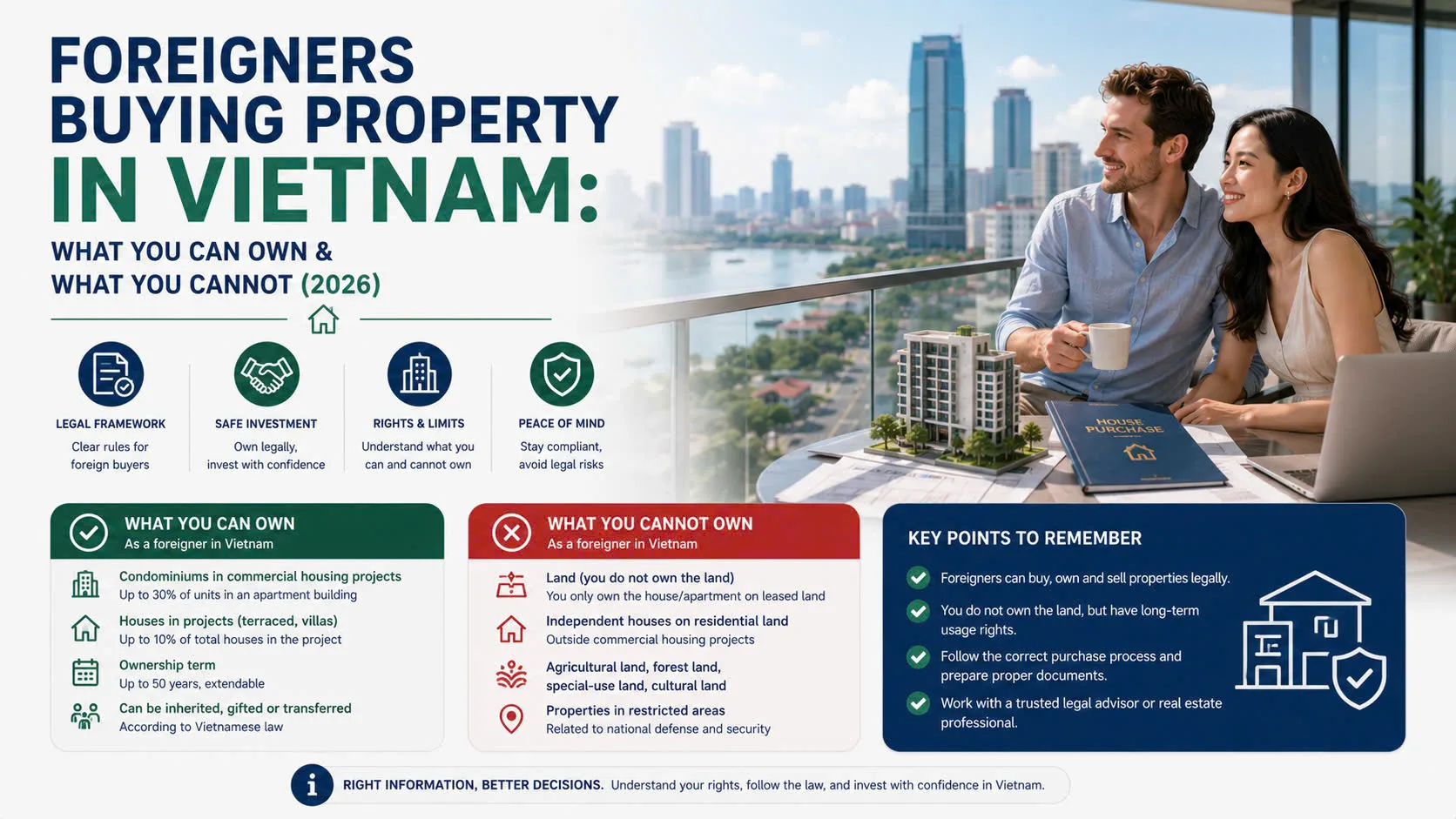
✅ WHAT YOU CAN BUY / ❌ WHAT YOU CAN'T
✅ YOU CAN:
- Apartments and houses (villas, townhouses) in commercial housing projects licensed for foreign ownership
❌ YOU CANNOT:
- Bare land / standalone land-use rights (land belongs to the people)
- Agricultural or forestry land
- Houses sold privately between individuals (outside licensed projects)
- Property in areas vital to security and defence
💡 The key point: you can only buy within a project licensed for foreign ownership — not freely on the open market like a local buying a standalone house.
📊 THE CAPS — TWO NUMBERS TO REMEMBER
Vietnam sets caps to protect housing for its own citizens:
- 🏢 Apartments: up to 30% of the units in a building/block
- 🏡 Landed houses: around 10% within a project, OR a maximum of 250 houses in a ward-equivalent unit (~10,000 population)
⚠️ Once a building hits its 30% foreign share, foreigners can only buy from other foreigners. Desirable projects fill their "foreign allocation" fast → confirm a specific unit's quota status in writing BEFORE you place a deposit.
⏳ OWNERSHIP TERM: NOT FOREVER
- Foreigners own on a 50-year leasehold, renewable (commonly cited as one extension, up to ~100 years)
- The clock starts when the Pink Book is issued (the Certificate of Land Use Rights and Ownership of Houses — the title document)
- Within that term you can live in it, rent it out, sell, and bequeath it
🆕 THE BIGGEST CHANGE: YOU CAN NOW RESELL TO FOREIGNERS
🔄 Previously, foreigners could only sell to Vietnamese citizens. Under the Housing Law 2023, foreigners can now RESELL TO OTHER FOREIGNERS — a major improvement in exit liquidity.
This is one of the most important shifts in the new framework (Housing Law 2023 + Land Law 2024).
💵 THE REALITY OF BUYING — WHAT FEW MENTION UPFRONT
- No residency required to buy, but you must have legally entered Vietnam
- Mortgages for foreigners are largely unavailable → most buyers pay cash
- All-in costs (taxes, fees, notarization…) typically run ~13–18% — budget for it
- You can rent it out (rental income is taxable). New: from the 2026 tax year, rental revenue up to VND 500 million/year is exempt from certain taxes — check current rules
🔗 Want to sell and move the money abroad? You'll usually need to show the funds CAME IN through documented channels. This is why the banking side matters from day one.
→ Banking & money for foreigners: getting money in and out
💍 AN IMPORTANT EXCEPTION: IF YOU MARRY A VIETNAMESE CITIZEN
If you're married to a Vietnamese citizen, you may be able to own property much like a local (without the 50-year term and caps above) — opening far broader ownership.
→ Married to a Vietnamese citizen & the TT visa: the long-stay route
🆕 Procedure: the Pink Book now issues at commune level
Since July 2025, first-time certificates (Pink Book) are issued at the commune-level People's Committee (the district level was abolished). If older material says "district level", it's out of date.
🔔 Not buying yet? Rent first and keep your visa solid
→ Renting as a foreigner: 5 traps to avoid
👉 Turn on free visa reminders with Visa Tracker — enter the date on your ENTRY STAMP, get alerts at 30 / 21 / 15 / 7 days. Free, no account needed.
⚠️ Common misconceptions
❌ "Buying a home means buying the land too." → NO. Nobody owns land in Vietnam. You own the house/apartment; land is a use right.
❌ "Foreigners can buy a standalone house on the open market." → NO. Only within a commercial project licensed for foreign ownership.
❌ "Ownership is forever like back home." → NO. Foreigners own on a term (50 years, renewable), not forever — unless married to a Vietnamese citizen.
❌ "I can buy freely in any project." → There's a 30% cap. Once the foreign share is full, you can only buy from foreigners. Check the quota before a deposit.
❌ "I can sell and move money abroad anytime." → You need to show funds entered through documented channels. Prepare the banking paperwork from the start.
❌ "Foreigners can't resell, so exit is hard." → That changed. The Housing Law 2023 allows resale to other foreigners.
Sources
- Housing Law 2023 and Land Law 2024 — the framework for foreign home ownership (apartments/houses in projects; no land ownership)
- Caps: 30% of units per apartment building · ~10% of landed houses per project or max 250 per ward-equivalent
- Term: 50 years, renewable · 2023 change: resale to foreigners allowed · From July 2025: Pink Book issued at commune level
- Costs and transaction practice compiled from real-estate advisory sources (2026); indicative, varies by project and timing
Note: This article compiles publicly available information as of the update date and is not legal or investment advice. Buying property is a major decision with legal and financial risk — verify with the authorities, the developer, and a qualified legal/real-estate advisor before any deposit or contract.
ViEntry is a technology platform connecting foreigners with independent service operators. ViEntry is NOT a real-estate broker and does NOT provide legal or investment services. All information is for reference.
Considering buying in Vietnam and want to understand the visa/residence side? Message us — we'll help with entry, E-Visa and direction so settling in goes smoothly.
🔗 Married to a Vietnamese — broader ownership? Married to a Vietnamese & the TT visa 🔗 Need to understand money in/out? Banking & money for foreigners 🔗 Not sure what you need? Free Advisor tool
Telegram @vientry_support · WhatsApp +84 963 091 001 · Hotline 0963 091 001