


🔄 Last updated: 11 July 2026
There's one field on the E-Visa application that most people tick without thinking: intended port of entry.
It's the most dangerous field on the form.
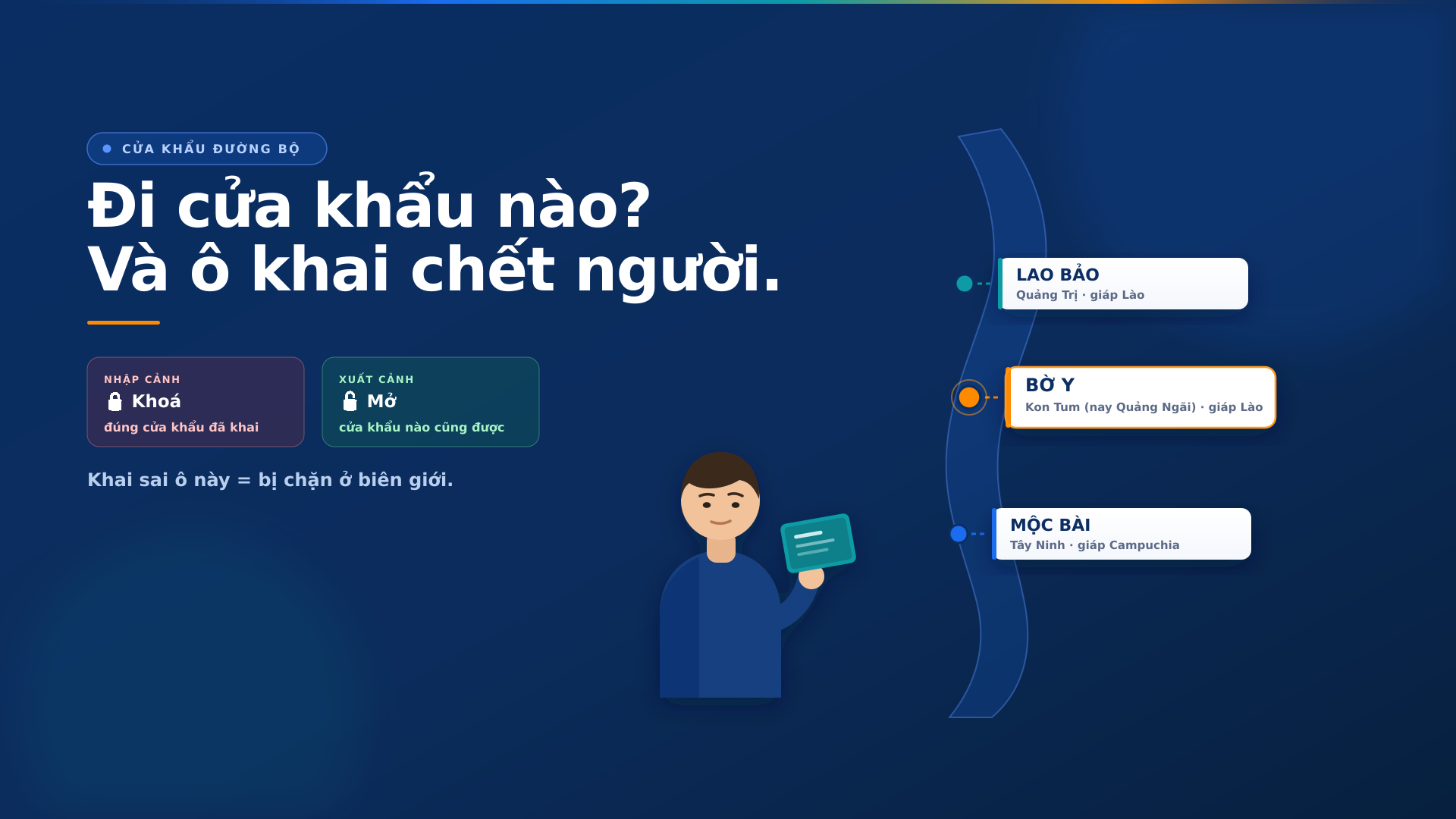
Per the Vietnam Immigration Department, once you select an entry port, you must enter through that specific port. Exit is flexible — any checkpoint on the list will do. Entry is not.
Which means: if you declared "Tan Son Nhat" and then try to come back overland through Moc Bai, your e-visa may not be accepted at the border. You'd be standing at a crossing, between two countries, holding a useless e-visa and a non-refundable fee.
This article makes sure that doesn't happen to you.
1. The golden rule: entry is locked, exit is open
| Entry | Exit | |
|---|---|---|
| Checkpoint | Must match the port declared on your e-visa | Any checkpoint on the list |
Fix this in your mind before reading on. Everything below hangs on it.
The practical consequence: if you plan to return to Vietnam overland, select that exact land crossing when you fill in the e-visa form — don't pick an airport "just to be safe".
2. Land crossings that accept an E-Visa
Under Resolution 127/NQ-CP (2023), as supplemented by Resolution 389/NQ-CP (2025).
The original 16 land crossings
| Crossing | Province | Borders |
|---|---|---|
| Moc Bai | Tay Ninh | Cambodia |
| Xa Mat | Tay Ninh | Cambodia |
| Ha Tien | Kien Giang (now An Giang) | Cambodia |
| Tinh Bien | An Giang | Cambodia |
| Vinh Xuong (land & river) | An Giang | Cambodia |
| Bo Y | Kon Tum (now Quang Ngai) | Laos |
| Lao Bao | Quang Tri | Laos |
| La Lay | Quang Tri | Laos |
| Cha Lo | Quang Binh (now Quang Tri) | Laos |
| Cau Treo | Ha Tinh | Laos |
| Nam Can | Nghe An | Laos |
| Na Meo | Thanh Hoa | Laos |
| Tay Trang | Dien Bien | Laos |
| Huu Nghi | Lang Son | China |
| Mong Cai | Quang Ninh | China |
| Lao Cai | Lao Cai | China |
Added by Resolution 389/NQ-CP (2025)
Land and rail: Dong Dang (rail, Lang Son) · Lao Cai (rail) · Tra Linh (Cao Bang) · Long Sap (Son La) · Nam Giang (Da Nang) · Le Thanh (Gia Lai) · Binh Hiep (Tay Ninh) · Tan Nam (Tay Ninh) · Thuong Phuoc (Dong Thap) · Dinh Ba (Dong Thap) · Thanh Thuy (Tuyen Quang).
⚠️ A note on province names. After Vietnam's administrative restructuring, several crossings now sit in different provinces than their traditional names suggest (Bo Y, Cha Lo, Ha Tien…). On the e-visa form, select by CHECKPOINT NAME, not by the province you remember.
3. The three most-used crossings, side by side
These are the three names you'll hear over and over in Vietnam's expat community.
| MOC BAI | BO Y | LAO BAO | |
|---|---|---|---|
| Province | Tay Ninh | Kon Tum (now Quang Ngai) | Quang Tri |
| Borders | Cambodia | Laos | Laos |
| Mainly serves | HCMC and the southern provinces | Central Vietnam & the Central Highlands | Central Vietnam |
| E-Visa | ✅ Yes | ✅ Yes | ✅ Yes |
| Character | The busiest crossing, with the most developed infrastructure and services | A common route for travellers starting in the south-central and highland regions | A long-established crossing on the East–West Economic Corridor |
How to choose — simpler than you think:
Don't pick "the most famous crossing". Pick by where you already are, because the expensive part isn't the visa fee — it's the distance and the time.
- In HCMC / the south → head toward Cambodia (Moc Bai, Xa Mat…)
- In Nha Trang / Da Nang / the Highlands → consider the Laos crossings (Bo Y, Lao Bao…)
- In the Mekong Delta → Ha Tien, Tinh Bien, Vinh Xuong
- In the north → China-facing (Huu Nghi, Mong Cai, Lao Cai) or Laos (Na Meo, Nam Can, Tay Trang)
4. Don't forget: you also need to get INTO the other country
This is the point most articles skip, and it's what makes people panic at the border.
An overland trip means two border crossings:
① Leave Vietnam → enter the neighbouring country. You must meet that country's entry conditions (Cambodia, Laos or China), under its own rules and depending on your nationality.
② Leave the neighbouring country → re-enter Vietnam. Only now does your new Vietnamese e-visa come into play — and it must match the declared checkpoint.
Entry conditions, fees and required documents for Cambodia / Laos / China are set by those countries and can change. Check their official channels, or ask your operator before you travel. Don't assume "I'm only crossing for a few hours, so I won't need anything."
🔔 Three mistakes that wreck the trip — and how to avoid them
Mistake 1 — Wrong entry checkpoint on the e-visa. Not fixable. Fee non-refundable.
Mistake 2 — E-Visa not approved in time. Officially, an e-visa can take up to 15 working days. Don't set off before the new visa is actually in hand.
Mistake 3 — Travelling too close to your expiry date. One small hitch at the border and you become an overstayer — and under Decree 282/2025/NĐ-CP, even under 16 days draws VND 500,000 – 2,000,000.
👉 Turn on free visa expiry reminders with Visa Tracker so you never have to travel in a sprint. Free, no account needed.
Not sure which crossing suits you? The free Advisor suggests one based on your nationality and where you're based.
5. ⚠️ Common misconceptions
❌ "Any checkpoint works, as long as I have an e-visa." → FALSE. You must enter at the checkpoint you declared. Only exit is flexible.
❌ "I'll declare an airport to be safe, then travel overland anyway." → FALSE. That's exactly how people get stopped at Moc Bai.
❌ "Every border crossing handles e-visas." → FALSE. Only the checkpoints on the list under Resolutions 127 and 389 accept e-visas. Secondary crossings and local border openings are not on it.
❌ "Bo Y is in Kon Tum, so I'll look for 'Kon Tum' on the form." → CAREFUL. Province names have changed after restructuring. Select by checkpoint name.
❌ "It's just a few hours in Cambodia/Laos, I won't need documents." → FALSE. You still have to enter that country under its own rules.
❌ "I'll just apply for the new e-visa at the border." → FALSE. E-Visas are filed online and cannot be submitted from inside Vietnam. You need the new visa before you turn back.
6. Before you set off overland
- Passport valid ≥ 6 months, with at least 2 blank pages
- New E-Visa approved, and the entry checkpoint on it matches the crossing you'll actually use
- Documents / entry conditions for the neighbouring country
- Cash — many land crossings don't take cards
- Spare passport photos (some procedures on the other side may require them)
- Photos of your passport and e-visa saved on your phone
7. Further reading
- Border Run — get the stamp, reset your permitted stay
- Visa Run — exit and re-enter on a fresh 90-day E-Visa
- Staying in Vietnam 3–6 months legally: 5 scenarios
- 7 reasons Vietnam E-Visa applications get refused
Sources
- Resolution 127/NQ-CP (14 Aug 2023) — list of international checkpoints for entry and exit on an electronic visa
- Resolution 389/NQ-CP (2025) — adding 41 international checkpoints
- Vietnam Immigration Department — Ministry of Public Security:
evisa.gov.vn - Vietnam Government Portal — announcement on additional e-visa checkpoints
- Decree 282/2025/NĐ-CP — Article 21, overstay penalties
Note: This article is informational and compiled at the time of the last update. The checkpoint list, rules and fees can change — check official channels before you travel. Entry conditions for third countries are set by those countries. Admission is decided by the immigration authorities. ViEntry is a technology platform connecting users with independent service operators; all prices are for reference. ViEntry is not an immigration authority and does not provide legal advice.
Need help choosing a crossing and preparing your file? Telegram @vientry_support · WhatsApp +84 963 091 001 · Hotline 0963 091 001