


🔄 Last updated: 11 July 2026
You want to skip winter back home. You work remotely. You have family in Nha Trang. Whatever the reason, the question is the same: how do you stay in Vietnam for months at a time, legally?
The answer isn't a single visa. It's assembling the pieces correctly — and knowing three hard limits that nobody gets around.
1. Three hard limits — learn them before they cost you
① Visa exemption = 45 days, and it cannot be extended in-country. Your arrival date counts as DAY 1, not day zero.
② E-Visa = up to 90 days, and it cannot be applied for from inside Vietnam. The Immigration Department's system detects that you're in the country. The application is almost certain to be refused — and the fee is non-refundable.
③ To extend your stay, you must LEAVE Vietnam. This is the part many people refuse to accept, but it underpins every scenario below. You exit, then re-enter on a new permission.
2. First: which visa-exemption group are you in?
Plenty of articles lump "24 visa-free countries, 45 days" into one bucket. In fact there are two separate resolutions with different conditions — and the difference can decide your trip.
| Resolution 44/NQ-CP | Resolution 229/NQ-CP | |
|---|---|---|
| Nationalities | Russia, South Korea, Japan, UK & Northern Ireland, France, Germany, Italy, Spain, Denmark, Sweden, Norway, Finland | Belgium, Bulgaria, Croatia, Czechia, Hungary, Luxembourg, Netherlands, Poland, Romania, Slovakia, Slovenia, Switzerland |
| Length | 45 days | 45 days |
| Purpose of entry | Any purpose | Tourism only |
| In force until | 14 March 2028 | 14 August 2028 |
⚠️ The key difference: citizens under Resolution 44 (which includes Russia and South Korea — the two largest visitor groups in Nha Trang) are visa-exempt regardless of passport type or purpose of entry. Citizens under Resolution 229 are exempt for tourism purposes under the tourism stimulus programme.
Separately: travellers of any nationality arriving directly at Phu Quoc from abroad get 30 days visa-free (subject to conditions).
3. 📅 Look up your trip length
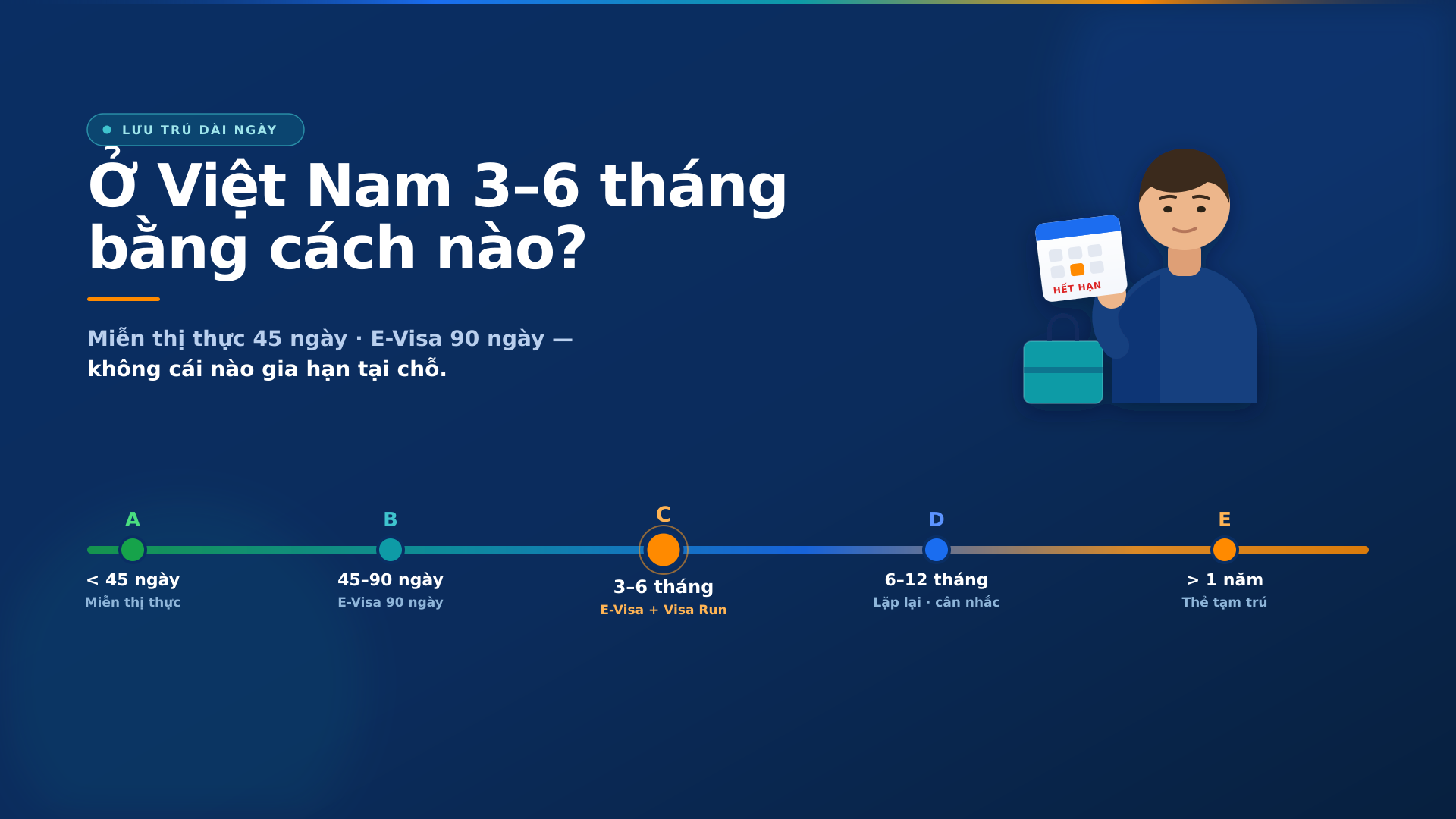
🟢 Scenario A — Under 45 days
What you need: a passport valid for ≥ 6 months + the digital arrival card (QR).
If you're visa-exempt, that's it. No visa, nothing else.
One thing to remember: count from arrival = day 1. Arrive 1 June → you must leave by 15 July at the latest.
🔵 Scenario B — 45 to 90 days
Exemption isn't enough. You need a 90-day E-Visa — and you must apply BEFORE ARRIVING, from outside Vietnam.
This is the costliest mistake long-stayers make: they enter visa-free "for convenience", then around day 40 realise they want to stay longer — and by then it's too late to apply for an e-visa (you can't file from inside the country).
If your trip might run past 45 days: don't use the exemption. Get a 90-day E-Visa from the start. The fee is USD 25 (single) or USD 50 (multiple) — far cheaper than an unplanned emergency border trip.
🟠 Scenario C — 3 to 6 months
This is the most common scenario for winter-stayers and remote workers. The formula:
90-day E-Visa → exit → new 90-day E-Visa → re-enter
That exit trip is the Visa Run: you leave Vietnam (usually via a land border), obtain a new e-visa from outside, then re-enter on a fresh 90-day permission.
Timing — this is where people get burned:
- Officially an E-Visa can take up to 15 working days (in practice often 3–5, but don't bet on it)
- You need the new e-visa already approved before you re-enter
- So: start preparing around day 60–70, not day 88
ViEntry supports both steps: E-Visa applications and Visa Run trips.
🟣 Scenario D — 6 months to a year
In theory you can repeat Scenario C. But be honest with yourself about three things:
- Costs compound. Every 90 days means another e-visa fee plus another exit trip.
- Risk accumulates. Every e-visa application is another chance of refusal — and the fee isn't refunded.
- You're building nothing. No residence card, no VNeID, harder to open a bank account or sign a long lease.
If Vietnam is becoming your base, it's time to consider the sponsored route.
🔴 Scenario E — Over a year
Now you need a Temporary Residence Card (TRC) — a document with the value of a visa, letting you come and go for years without visa runs.
But a TRC cannot be obtained directly from an E-Visa or a visa exemption. The real path is:
Work permit or investment registration → LĐ or ĐT visa → TRC
That's a journey of months, not days. Details in Vietnam Temporary Residence Card 2026.
🔔 The real trap isn't the law — it's the calendar
Nobody overstays on purpose. People simply miscount, or postpone the paperwork until it's too late.
And the price is very specific: under Decree 282/2025/NĐ-CP, an overstay of under 16 days already draws VND 500,000 – 2,000,000. Cross into day 16 and the fine jumps to VND 5–10 million, with deportation available as an additional penalty.
One reminder 15 days out is enough to never read that table.
👉 Turn on free visa expiry reminders with Visa Tracker — no account needed. Telegram or email.
4. The three routes side by side
| Visa exemption | E-Visa | TRC | |
|---|---|---|---|
| Length | 45 days | Up to 90 days | 2 – 10 years by symbol |
| Where you apply | No application | Online, from outside Vietnam | Inside Vietnam, via a sponsor |
| Government fee | Free | USD 25 / USD 50 | approx. USD 145 – 155 |
| Sponsor needed? | No | No | Yes |
| Extendable in-country? | No | No | No — you apply for a new card |
| Multiple entries? | Each entry starts a new exemption | Depends (single/multiple) | Yes, for the card's whole term |
5. ⚠️ Common misconceptions
❌ "I'm near the end of my 45 days — I'll apply for an e-visa online to stay longer." → FALSE. You cannot file an e-visa from inside Vietnam. You must exit first.
❌ "I'll enter visa-free and figure it out later." → VERY RISKY if your trip could exceed 45 days. By the time you're "figuring it out", your only option is a rushed exit trip. If a long stay is possible — get the 90-day E-Visa from the start.
❌ "I'll just hop out and come back for another 45 visa-free days, forever." → BE CAREFUL. Admission is decided by the border officer, based on the entry conditions in force. A pattern of continuous in-and-out can be scrutinised. Don't build a long-term plan on this assumption.
❌ "The QR arrival card is a visa." → FALSE. It's an electronic arrival declaration, filed within 72 hours of arrival, free of charge. It does not replace a visa and adds nothing to your permitted stay.
❌ "45 days visa-free means I can do anything." → DEPENDS ON YOUR GROUP. Citizens under Resolution 229 are exempt for tourism purposes. Citizens under Resolution 44 (Russia, South Korea…) are exempt regardless of purpose. Check which group you're in.
❌ "A few days over is fine — I'll pay at the airport." → FALSE. Once your visa has expired, you cannot simply depart as normal. See the seven-tier fine table under Decree 282/2025.
6. ✅ Pre-flight checklist
- Passport valid ≥ 6 months from arrival, with ≥ 2 blank pages
- Work out your real trip length → pick the right scenario A–E above
- If you might stay over 45 days → get the E-Visa before you fly, don't rely on the exemption
- File the digital arrival card (QR) at
prearrival.immigration.gov.vnwithin 72 hours of arrival - Put the expiry date in your calendar + set a reminder at least 15 days ahead
- Ask your landlord/hotel to file your temporary residence declaration on day one
Not sure which scenario is yours? The free Advisor suggests one based on your nationality and dates.
Sources
- Resolution 44/NQ-CP (7 Mar 2025) — visa exemption for 12 countries, in force 15 Mar 2025 – 14 Mar 2028
- Resolution 229/NQ-CP (11 Aug 2025) — visa exemption for 12 countries under the tourism stimulus programme, in force 15 Aug 2025 – 14 Aug 2028
- Ministry of Foreign Affairs — Vietnam's visa exemption list by country
- Vietnam Immigration Department — Ministry of Public Security: evisa.gov.vn · prearrival.immigration.gov.vn
- Decree 282/2025/NĐ-CP — Article 21, overstay penalties
- Vietnam Government Portal — announcements on new visa exemption policies
Note: This article is informational and compiled at the time of the last update. Visa exemption policies, fees and processing times can change — check official channels before starting any procedure. Admission and the length of stay granted are decided by the immigration authorities. ViEntry is a technology platform connecting users with independent service operators; all prices are for reference. ViEntry is not an immigration authority and does not provide legal advice.
Need help planning a long stay? Telegram @vientry_support · WhatsApp +84 963 091 001 · Hotline 0963 091 001