
🔄 Last updated: 21 July 2026
You don't need to be perfect — just respectful
Vietnamese people are hospitable and usually forgive an honest mistake made out of not knowing. But a few small courtesies will make you well-liked and smooth every interaction.
🔑 Here are the dos and don'ts by situation. These are general customs — individuals and regions vary, so observe and stay flexible.
🏠 Entering a Vietnamese home
- Take your shoes off before going in (look for sandals left at the door)
- If offered food, accepting warmly shows appreciation; bringing a small gift (fruit, cake) is a nice touch
- Give and receive things with both hands (or your right hand) with elders, as a sign of respect
🛕 At temples and places of worship
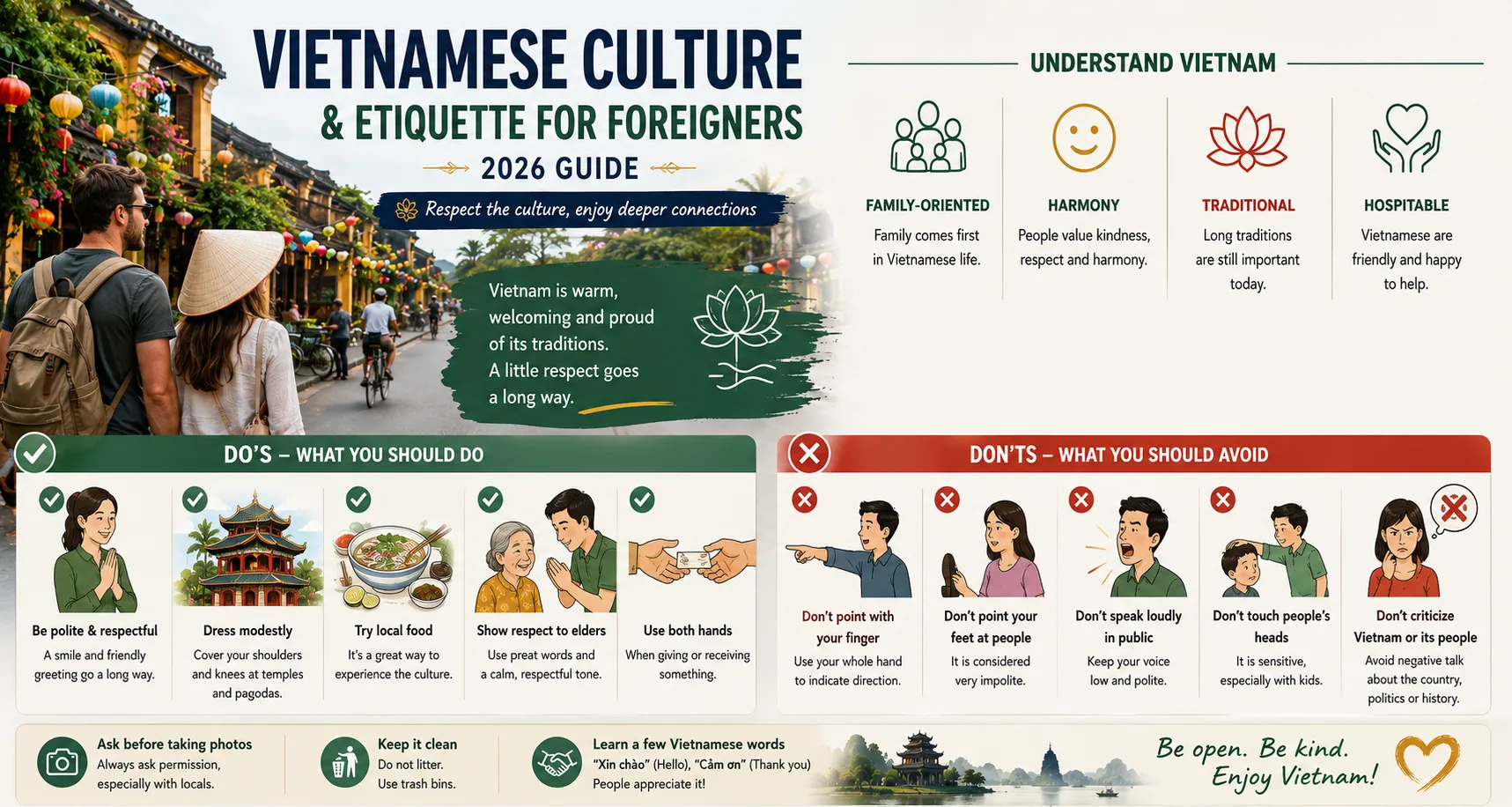
- Dress modestly: cover shoulders and knees
- Remove your shoes entering worship areas if asked
- Lower your voice, no loud joking; ask before photographing statues/altars
- Don't point your feet toward statues/altars; don't touch sacred objects
🍜 At the table
- Vietnamese meals usually share dishes, with a bowl of rice each — take from what's near you
- Don't stick chopsticks upright in a rice bowl (it evokes offerings to the deceased)
- Inviting elders to eat first is a nice gesture
- Slurping/praising the food is seen as polite and friendly
🗣️ Communication & "saving face"
- Stay calm, avoid raising your voice in public. "Face" matters — losing your temper or embarrassing someone in front of others usually backfires
- A smile defuses a lot; patience and gentleness work better than pressure
- Vietnamese people may ask about your age, family, marriage — this is usually friendly interest, not nosiness
- Learn a few words like "xin chào" (hello), "cảm ơn" (thank you) — locals appreciate the effort
💵 Money, tipping & bargaining
- Tipping isn't traditionally required, but it's appreciated at tourism-facing restaurants/hotels/spas
- Bargaining is normal at markets and street stalls — keep it light and friendly; but don't bargain at fixed-price shops/supermarkets
- Pay in VND and agree the price first to avoid misunderstandings → Beware scams
🚫 A few things to avoid
- Don't pat people on the head (even children) — the head is considered special
- Don't point with a finger at people; gesture with your whole hand
- Don't overdo public displays of affection
- Handle sensitive topics gently: approach history/politics with tact, and listen more than you speak
🎎 A few occasions worth knowing
- Tết (Lunar New Year) (around Jan–Feb, by the lunar calendar): the most important holiday; many places close for several days → Best time to visit Vietnam
- Being invited to a wedding/memorial is an honour — a small gift envelope is appropriate
⚠️ Common misconceptions
❌ "I must master the customs to be accepted." → No. Vietnamese people are forgiving; a respectful attitude matters more than perfection.
❌ "You can bargain everywhere." → Only at markets/street stalls; not at fixed-price shops.
❌ "Asking about age/marriage is rude." → In Vietnam it's usually friendly interest.
❌ "Get loud when there's a disagreement to make your point." → It usually backfires — stay calm and preserve both sides' face.
Sources
- Common customs and courtesies in Vietnam (shoes off in homes, modest dress at worship sites, chopsticks, "saving face", tipping, bargaining) — general in nature and varying by region and individual; observe and respect the context
Note: This article describes common customs for reference, respecting regional and individual diversity. ViEntry is a technology platform supporting foreigners with E-Visa, Visa Run Tour, Fast Track, and Visa Tracker; it is not an immigration authority.
New to Vietnam and want to settle in smoothly (visa included)? Message us — free advice in your language.
🔗 Living in Nha Trang for foreigners: Read the guide 🔗 HCMC for first-time foreigners: Read the guide 🔗 Safety & avoiding scams: Read the guide 🔗 Turn on visa reminders: Visa Tracker
Telegram @vientry_support · WhatsApp +84 963 091 001 · Hotline 0963 091 001