


🔄 Last updated: 17 July 2026
The thing you hope you'll never need — but must know in advance
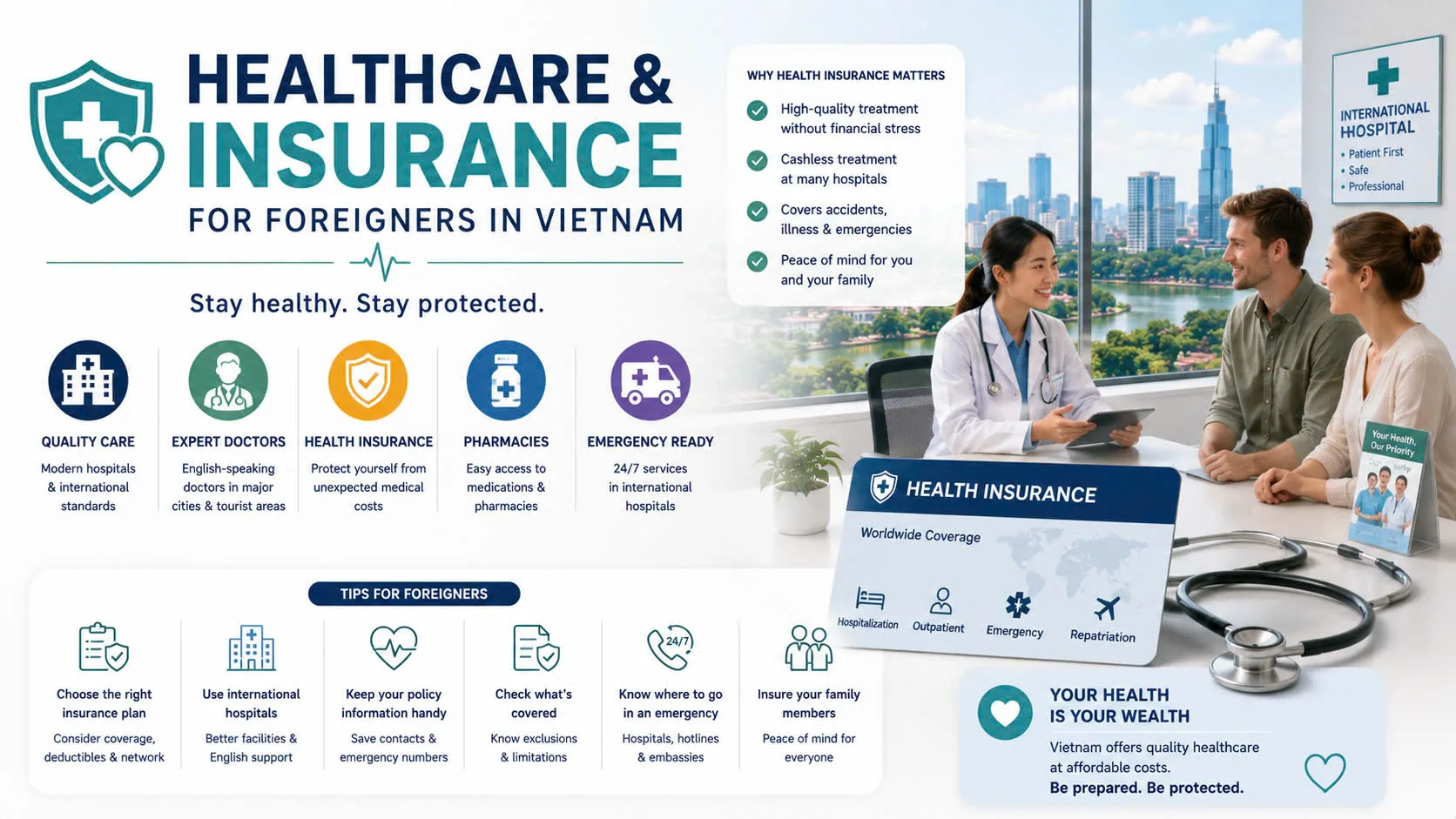
Nobody plans to get sick abroad. But at that exact moment — a fever at midnight, a scooter accident, sharp abdominal pain — what decides the outcome isn't luck; it's whether you KNOW in advance what to do.
And there's a hard truth to grasp from the start:
🛑 Foreigners are NOT covered by Vietnam's public health insurance — except foreign workers with a work permit (and even then, within a restricted network). That means this is on you to arrange.
Here's how to handle it, by SEVERITY.
🟢 LEVEL 1 — MINOR: GO TO A PHARMACY
Cold, cough, mild stomach upset, an allergy — usually sorted at a pharmacy.
- Pharmacies in Vietnam are plentiful and easy to find — in malls, on main streets
- You can usually buy medicine over the counter (OTC)
- ⚠️ BUT check the expiry date and source — expired or poor-quality medicine can appear. Prefer large, reputable pharmacies
💡 If you take long-term prescription medicine, bring enough from home, in the original labelled boxes. Don't count on finding the exact drug/brand here.
🟡 LEVEL 2 — YOU NEED A DOCTOR: CHOOSE THE RIGHT FACILITY
When you genuinely need to be seen, you have two options — and the gap is large:
🏥 INTERNATIONAL hospital / clinic (FV, Vinmec, Family Medical Practice…) International standard, English-speaking doctors, clear processes, often billing directly with insurers. Concentrated in HCMC, Hanoi, Da Nang. Much more expensive — but this is where complex cases are handled.
🏨 Public hospital Cheaper, but a big language barrier (staff usually speak only Vietnamese), crowded, with equipment and experience different from the West.
💡 Per 2026 sources, medical costs in Vietnam are meaningfully lower than in the West, but far from small without insurance. A single GP visit at an international hospital can run into the hundreds of dollars.
🔴 LEVEL 3 — EMERGENCY: KNOW THE NUMBER, KNOW THE WAY
🚑 National medical emergency number: 115.
But be realistic: ambulances can be slow, staff rarely speak English, equipment may be dated.
- Ho Chi Minh City has a private 24/7 emergency service (9999) — faster response, better-equipped ambulances
- If your condition allows, many people take a Grab/taxi to a private hospital faster than waiting for an ambulance
- Very serious/complex cases may need evacuation to Singapore or Bangkok — which is why an insurance policy's "emergency evacuation" clause matters so much
💡 TODAY: save into your phone the number 115, your nearest private hospital, and your insurer. Prepare a list of allergies / conditions in both English and Vietnamese.
🛡️ INSURANCE — THE PART THAT DECIDES
Since public insurance won't cover you, and many private hospitals ask for proof of insurance before treatment, this is the part not to skip.
Three common types:
- International health insurance — best for long-stayers: covers both routine and emergency care, lets you choose the hospital, and includes emergency evacuation. Higher premium but flexible
- Local insurance (Vietnamese company) — lower premium, but limited international benefits
- Short-term travel insurance — for short-stay visitors/nomads (usually 30–90 days), emergencies only, not long-term care
⚠️ If you often travel to Thailand/Singapore for specialist care, make sure your policy covers treatment OUTSIDE Vietnam.
Is insurance required to get a visa?
As of 2026, health insurance is NOT required for tourists / E-Visa. But:
- Some work permits may require insurance under the contract
- Some temporary residence card / long-term visa categories may request proof of insurance
→ Vietnam Temporary Residence Card 2026: who qualifies → Staying in Vietnam 3–6 months legally: all your options
🔔 Health and visa: the same principle
Both are easy to forget until it's too late. Don't let a bout of illness make you miss your visa-renewal date.
👉 Turn on free visa reminders with Visa Tracker — enter the date on your ENTRY STAMP, get alerts at 30 / 21 / 15 / 7 days. Free, no account needed.
⚠️ Common misconceptions
❌ "Vietnam has universal health coverage, so I'm covered too." → NO. Foreigners are not covered by public insurance (except work-permit holders, and even then within limits). It's on you.
❌ "Just call 115 and an ambulance comes fast." → It can be slow and rarely English-speaking. If you can move, a Grab to a private hospital is sometimes faster. HCMC has a private service (9999).
❌ "My travel insurance covers everything." → NO. Travel insurance usually covers short-term emergencies only, not long-term treatment. Read the fine print.
❌ "Pharmacy medicine is always fine." → Check the expiry date. Expired/poor-quality medicine can appear. Prefer reputable pharmacies.
❌ "I need insurance to get a tourist visa." → Not required for tourists/E-Visa. But some long-term visas/work permits may request it.
Sources
- National medical emergency number: 115 (HCMC has a private emergency service, 9999)
- Public insurance policy — foreigners are not covered by public health insurance, except work-permit holders (restricted network)
- Healthcare & insurance for foreigners — compiled from guidance sources (2026); costs and benefits are indicative and vary by facility and policy
Note: This article compiles publicly available information as of the update date and is not medical, financial or legal advice. In an emergency, call 115 or go to the nearest facility. Insurance benefits vary by policy — verify directly with your provider.
ViEntry is a technology platform connecting foreigners with independent service operators. ViEntry is NOT a medical facility or an insurer. All information is for reference.
Staying long and need to understand the visa/residence side of long-term insurance? Message us — we'll help with the residence & visa part.
🔗 Staying long, need to understand the TRC? Vietnam Temporary Residence Card 2026 🔗 Want visa reminders? Free Visa Tracker 🔗 Not sure what you need? Free Advisor tool
Telegram @vientry_support · WhatsApp +84 963 091 001 · Hotline 0963 091 001